The
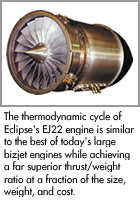
Eclipse 500 jet is powered by the super-compact and super-efficient
EJ22, a breakthrough innovation designed and manufactured
exclusively for Eclipse by world-renowned Williams International.
The EJ22 engine is a special, commercial version of the
FJX-2 engine Williams demonstrated under a $100 million
cost-sharing program with NASA, as part of NASA's General
Aviation Propulsion (GAP) program. Weighing approximately
85 lbs, and delivering over 770 lbs. of thrust, the engine
provides a higher thrust-to-weight ratio than any commercial
turbofan ever produced. It is also the smallest, quietest
and lightest commercial aircraft engine, and makes feasible
a whole new class of twinjet light aircraft.
| EJ22
Performance Comparison |
| |
Eclipse
500
|
Gulfstream
V
Global Express
|
| Engine
Model |
EJ22
|
BRR710
|
Sea
Level Static
Thrust (lbf) |
770
|
16,500
|
| Bypass
Ratio |
4.6
|
5.3
|
| Weight
(lb) |
85
|
3,500
|
| Thrust/Weight
Ratio |
9.05
|
4.71
|
|
By
partnering with Williams
International, Eclipse will leverage years of successful
turbofan innovation.
Low
noise level
The quiet EJ22 will be welcome at small airports across
America. Noise predictions have been conducted at Williams
International, using the NASA noise program. Excellent correlations
of predicted versus actual noise levels have previously
been achieved with Williams International's FJ44-1 used
on Cessna CJ1.
EJ22
Engine Noise Assessment
Noise Levels in EPNdB |
| |
Takeoff
|
Sideline
|
Approach
|
Delta
Stage 3
|
Stage
3 Requirements
Stage 4 (proposed)* |
89.0
86.0
|
94.0
91.0
|
98.0
95.0
|
-
-9.0
|
Cessna
CJ1 Predicted
Cessna CJ1 Actual |
75.9
73.4
|
86.0
83.7
|
94.9
92.1
|
-24.2
-31.8
|
| Eclipse
500 Predictions |
68.0
|
82.0
|
80.0
|
-51.0
|
|
*Stage
4 performance not currently required in U.S.
EJ22 Testing
The
first flight of the EJ22 engine occurred on May 30, 2002
at approximately 3:00 pm PT in Reno, Nevada, on a Saberliner
60 modified to serve as a flying test bed (FTB). The flight
lasted approximately 50 minutes and took the Williams International
EJ22 engine through the entire flight envelope that is planned
for the first flight of the Eclipse 500 scheduled for later
this summer. The engine performed flawlessly throughout
the flight.
The
FTB is testing the capabilities of the EJ22 in flight, including
FADEC software development, relight characteristics, and
operating envelope. Testing the EJ22 on the FTB significantly
reduces the risk associated with first flight of the Eclipse
500 and provides valuable information for Williams International
throughout the flight test program.
Ten
test engines have accumulated more than 675 hours of testing
at Williams International's sea level static test facility
and at NASA Glenn Research Center's altitude test facility.

Overview
| Engine | Guarantees
| Specs | Performance
| Avio | Interior | Multimedia
| Images | Price & Availability
| FAQ
|